LA Sports Hall of Fame - Sonja Hogg
6/29/2009 12:00:00 AM | Women's Basketball
June 29, 2009
In 1974, Sonja Hogg did not go to Louisiana Tech as a basketball coach. She had not played basketball at Bolton High in Alexandria or Tech, because the sport wasn't available at either school, and had not coached basketball at Ruston High. She was being interviewed by Tech's president, Dr. F. Jay Taylor, for a physical education teaching position.
During the interview, Dr. Taylor mentioned three young ladies coming to his office expressing an interest in starting a women's basketball team at Tech, and asked if she would be interested in the project. "I'll be happy to," she replied.
It was an inauspicious start to an incomparable coaching career, one which has carried her into the Women's Basketball Hall of Fame earlier this month, and as of June 27 in Natchitoches, the Louisiana Sports Hall of Fame alongside the state's greatest figures from all sports fields.
Hogg, who will be the second female college coach inducted into the Louisiana Sports Hall of Fame, recalls that interview 35 years later and says, "We were off and running."
Dr. Taylor told her he wanted the team to look nice, with attractive uniforms. With a budget of $5,000, Hogg felt that would be no problem. He also told her he didn't want the team to be an appendage of the men's team.
That would be no problem, either. Within six years, Tech had to discontinue playing doubleheaders with a women's game followed by a men's game because most of the spectators were leaving the gym after the women's game.
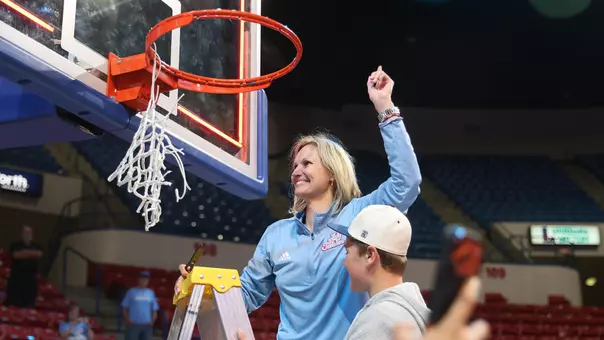
By that time, the Lady Techsters were already perennial national powers, on their way to three national championships and six consecutive national Final Four appearances.
Hogg calls Dr. Taylor "a visionary." But neither of them, nor anybody else, had a hint of the scope of the vision they first discussed in that interview, before Hogg was hired as a physical education teacher.
Her first team played only three home games, but finished the season with a 13-9 record -- the first of 35 consecutive winning seasons for the Techsters, a streak that is still intact. Two of the 13 victories that season were against LSU.
During the early years, she made frequent trips to Ruston High to seek advice from Leon Barmore, who was coaching the boys' basketball team at his alma mater, on such problems as how many water bottles they would need on the bench during games. Hogg had never been on a basketball team at any level. At that time, the women's basketball team was not part of the athletics department. She answered only to Harry Williams, the chairman of the Health and Physical Education Department, and Dr. Taylor.
After three winning seasons, she hired Barmore as an assistant coach. After another winning season, she decided it was time to expand beyond Louisiana and its surrounding states. She suggested a trip to another part of the country to Dr. Taylor.
"Where do you want to go?" he asked.
"California," she answered.
So the 1978-79 schedule included a trip to California for three games with Pepperdine, UCLA and Southern California. But a week before they made that trip, the Techsters attracted national attention with a 64-56 victory over Tennessee in a Mississippi tournament. Tennessee was ranked No. 1 in a national women's basketball poll conducted by Mel Greenberg of the Philadelphia Inquirer. Before that game, the Techsters' only victory over a nationally-ranked team was a one-point squeaker past No. 17 Stephen F. Austin the previous season.
The trip to California was the first time most of the players and some members of the staff had ever been on an airplane. When they returned to Shreveport after winning all three games, they learned they were ranked No. 8 in Greenberg's poll. By the end of the season, when they lost to Old Dominion in the national finals, they were No. 2.
But the winning was only beginning. The Techsters would be ranked No. 1 for three consecutive seasons, and would finish nine consecutive seasons among the Top Four in final national polls.
Louisiana Tech has been the No. 1 seed in NCAA tournaments 10 times. The only teams above the Techsters on that list are Tennessee and Connecticut.
As the program's success skyrocketed, Hogg continued relationships she had developed with such coaches as Billie Moore of UCLA and Pat Summitt of Tennessee in the infancy of women's basketball. When Summitt brought her Tennessee teams to Ruston on road trips, Hogg picked her up at the Holiday Inn and took her home where they would visit while they washed the Lady Vols' uniforms.
She and Summitt remain close today. Recently, on a national sports talk radio show, Summitt spoke about how the women's game has developed, and repeatedly cited the Lady Techsters, built from scratch by Hogg with Taylor's support, as one of the iconic programs in the history of the sport.
In fact, a survey of women's basketball fans not long ago tabbed the Hogg-built Techsters as No. 2 in "brand recognition" in the sport, trailing only Summitt's powerhouse Lady Vols. As a tribute to that sort of impact, in 2004, Hogg was awarded the Naismith Women's Outstanding Contribution to Basketball award.
"I have so much respect for her and the things she's done for women's basketball," said former Texas Tech coaching icon Marsha Sharp. "If you look back at some of the personalities who were so instrumental in taking women's basketball to another level, Sonja has to be included in that group."
It didn't happen without Hogg being willing to bring on board tremendous coaching talent to pave the way. Barmore stepped into the college game from Ruston High and eventually took over the program in a career that has carried him not only to the Louisiana Sports Hall of Fame but the Naismith Basketball Hall of Fame in Springfield, Mass.
Gary Blair, now the highly successful women's basketball coach at Texas A&M after strong runs in charge at Arkansas and Stephen F. Austin, joined the Techsters' staff after a stint at South Oak Cliff High in Dallas. Hogg met him while she was recruiting Debra Rodman at South Oak Cliff, and has fond memories of recruiting trips on which she and Barmore would draw straws to determine which one would ride in the front seat when Blair was driving.
Blair was an avid fan of the Texas Rangers, and always had sports sections of the Dallas Morning News. He made recruiting trips interesting by eating a Whopper, reading the Morning News and listening to Rangers games while he drove.
"Thank goodness we didn't have cell phones then," Hogg recalls. "If we had them, we'd all be dead."
They made phone calls from pay phone booths in those days, and Hogg knew where every phone booth between Ruston and Dallas was located.
Two of that Lady Techsters' coaching staff are now in the Women's Basketball Hall of Fame, and the driver (Blair) will probably be joining them before long.
Three players Hogg recruited and coached (Kim Mulkey, Janice Lawrence and Pam Kelly) are already in the Louisiana Sports Hall of Fame, along with Barmore.
"Coach Hogg, I can't put into words what she meant to us," said Lawrence, who like Mulkey and Kelly is also in the Women's Basketball Hall of Fame. "She coached us in life. We had a great coaching staff and each of them gave us things that made us better individually, and made us a great team."
When Mulkey, now a national championship-winning coach herself at Baylor, became the youngest-ever enshrinee in the Louisiana Sports Hall of Fame in 1990, she picked Hogg and Barmore to introduce her. One observer remarked later that evening that seeing the rapport between the two colleagues "was almost like watching Sonny and Cher."
Hogg didn't hesitate when she had to choose whom to introduce her in Natchitoches. It was Barmore, who ironically has reunited with Mulkey and Hogg at Baylor, where he last year came out of retirement to serve as an assistant coach for the Lady Bears - going up against Blair and the Lady Aggies of A&M in Big XII Conference battles.
Gunter, the only other female coach in the Louisiana Sports Hall of Fame, was posthumously enshrined in both the Louisiana Sports Hall of Fame and Women's Basketball Hall of Fame in 2005. She was coaching at Stephen F. Austin when Hogg and Barmore developed a national powerhouse at Louisiana Tech.
But Hogg is the only member of that trio who never played basketball at the high school or college level (or any other level).
She's working at another level now, in the Office of Gift Planning at Baylor, developing and maintaining relationships with high-end donor prospects for the university. Hogg worked in a similar capacity in athletics for the University of Texas in 1988-90.
Hogg came out of coaching retirement in 1994 and took over a floundering Baylor basketball program. She carried the Lady Bears to a 22-win season in 1997-98, led Baylor to its first postseason appearance in 17 years - a championship game appearance in the 1998 WNIT - and more than doubled the program's previous attendance records, turned down an offer to coach professionally, and finally hung up her whistle in 2000, shifting to the development arm of the university.
It's an appropriate role for somebody who developed one of the most iconic, successful programs in sports history.